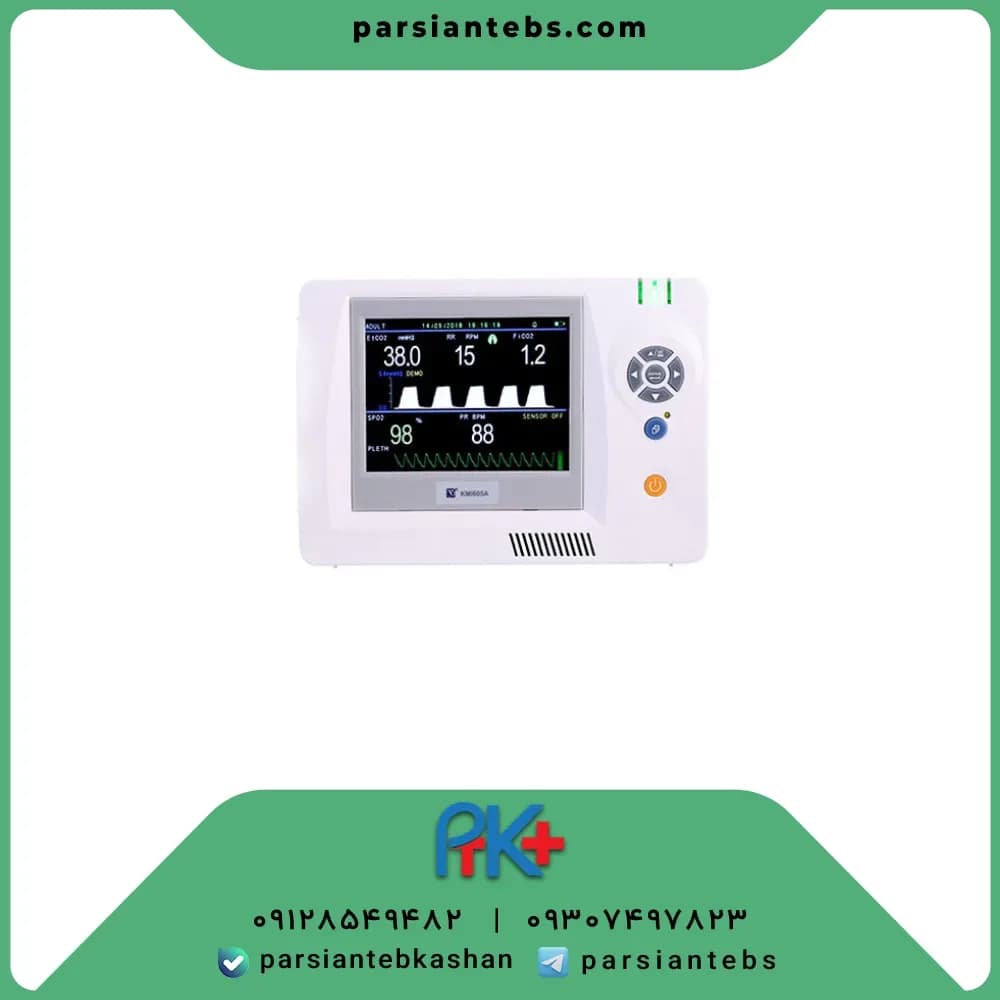
Kingst KMI605A capnograph
Need assistance?
Product description
Introducing the Kingst KMI605A capnograph
The Kingst KMI605A capnograph is a professional device for continuous, real-time monitoring of a patient's respiratory status which, in addition to measuring end-tidal carbon dioxide (EtCO2), also allows monitoring of parameters such as respiratory rate, blood oxygen saturation and heart rate.
This device is a practical option for clinical settings where precise respiratory monitoring is very important; intensive care units (ICU), operating rooms, emergency departments, anesthesia and monitoring of intubated patients are among the areas where it can be used.
One key point in the design of the KMI605A is that it can be used as a stationary or mobile unit, so it can be placed at the patient's bedside or moved as working conditions require. The device also features automatic atmospheric pressure compensation, which helps maintain monitoring accuracy under different environmental conditions.
What is a capnograph and why does EtCO2 matter?
A capnograph is a device that measures the amount of carbon dioxide in a patient's exhaled air and monitors its changes. The most important parameter of this device is EtCO2 (end-tidal carbon dioxide).
EtCO2 monitoring can give the care team valuable information about the patient's ventilation status. That is why capnographs are highly important in settings such as anesthesia, operating rooms, ICU and emergency departments.
Kingst KMI605A provides, in addition to EtCO2, respiratory parameters and, in the relevant configuration, SpO2 and PR, which makes it a suitable solution for multi-parameter monitoring of respiratory status.
Main features and benefits of the Kingst KMI605A capnograph
Continuous EtCO2 monitoring
One of the most important capabilities of the KMI605A is continuous measurement of CO2 and EtCO2 values. According to the manufacturer's specifications, the device's CO2 measurement range is 0 to 150 mmHg and the device can display the EtCO2 value and waveform for monitoring respiratory status.
Respiratory rate (RR) measurement
This device can monitor Respiratory Rate (RR) in the range of 3 to 150 breaths per minute. This feature is useful for tracking the patient's breathing pattern and observing changes over time.
SpO2 and heart rate monitoring
In the relevant configuration, besides capnography, the KMI605A can measure SpO2 and Pulse Rate (PR) as well. The SpO2 monitoring range is stated as 50 to 100 percent and the heart rate range as 30 to 250 beats per minute.
As a result, the user can view key information related to the patient's respiratory and oxygenation status on a single monitoring system.
Automatic atmospheric pressure compensation
One of the practical capabilities of the Kingst KMI605A is Automatic Atmospheric Pressure Compensation technology, which helps the device deliver more stable measurements under different ambient pressure conditions.
The manufacturer also highlights this capability for situations such as high-altitude areas and even air ambulance use.
No Zero Calibration needed at startup
According to the manufacturer, the KMI605A can start measuring after being switched on without an initial zero calibration. This can simplify device preparation and is useful in clinical settings where speed matters.
Durable design suited to clinical settings
The device is built for continuous use in professional clinical settings. Its rugged housing and relatively simple maintenance make the KMI605A suitable for settings such as the ICU and operating room.
Mainstream and Sidestream options
Another important feature of this model is its support for both Mainstream and Sidestream methods. The appropriate method can be chosen based on the patient's condition and the intended use.
In the Sidestream method, a sample of respiratory gas is carried to the device through a sampling line; this method is used in applications such as monitoring intubated patients and situations where humidity control is important.
Long battery operation
Kingst has equipped this device with a lithium battery, and according to official information, at full load the battery can provide more than 12 hours of continuous operation. This feature matters for centers that need to move the device in addition to using it in a fixed location.
Applications of the Kingst KMI605A capnograph
The KMI605A capnograph can be used in various clinical settings and situations, including:
Intensive care unit (ICU): for continuous monitoring of patients' respiratory status
Operating room: for monitoring EtCO2 and respiratory parameters during anesthesia
Emergency department: for rapid assessment and monitoring of respiratory status
Anesthesia department: for monitoring exhaled CO2 and respiratory rate
Monitoring intubated patients: for checking ventilation status and EtCO2
Patient transport and transfer: thanks to its mobile-use capability
Medical centers and hospitals: for ongoing monitoring of respiratory parameters
Technical specifications of the Kingst KMI605A capnograph
Specification | Value |
|---|---|
Brand | Kingst |
Model | KMI605A |
Device type | Tabletop / portable capnograph |
Main parameters | EtCO2, CO2, RR |
Additional parameters | SpO2 and PR |
CO2 measurement range | 0 to 150 mmHg |
RR range | 3 to 150 breaths per minute |
SpO2 range | 50 to 100 percent |
SpO2 accuracy | Maximum ±2% in the 70 to 100% range |
Pulse Rate range | 30 to 250 bpm |
Gas sampling flow range | 50 to 250 cc/min, optional |
Measurement methods | Mainstream and Sidestream |
Atmospheric pressure compensation | Yes |
Zero calibration at startup | Not required, per manufacturer specifications |
Power supply | 220V, 50Hz / 12V 1.8Ah battery |
Battery type | Lithium |
Battery operating time | More than 12 hours at full load |
Operating temperature | 5 to 40 degrees Celsius |
Operating humidity | 30 to 75 percent, non-condensing |
Atmospheric pressure | 86 to 106 kPa |
Note: Some configurations of the KMI605A/B family may differ in terms of SpO2, PR or the type of measurement module; so when buying, ask the seller about the exact configuration of the device and its included accessories.
Why choose the Kingst KMI605A capnograph?
When choosing a capnograph, EtCO2 measurement is not the only thing that matters; consistent performance, usability in different conditions, sampling method, the ability to monitor additional parameters and the cost of consumables are also important.
Kingst KMI605A aims to bring several key respiratory monitoring needs together in one device by offering EtCO2 and RR monitoring and, in the relevant configuration, SpO2 and PR. Atmospheric pressure compensation, support for Mainstream and Sidestream methods and long battery operation are further features that set it apart for professional use.
The device is also designed so that it can be placed in a fixed position in the clinical setting or moved when needed. This matters for medical centers, operating rooms and care units where equipment must be moved according to the patient's situation.
What is the difference between a capnograph and a pulse oximeter?
One common question when buying respiratory monitoring equipment is the difference between a capnograph and a pulse oximeter.
A pulse oximeter is mainly used to measure SpO2 and heart rate, whereas a capnograph provides information about ventilation and the patient's respiratory status by analyzing the CO2 in exhaled air.
For this reason, the two devices do not necessarily replace each other, and in many clinical settings they can be used side by side.
Depending on its configuration, the KMI605A can also monitor SpO2 and PR in addition to EtCO2, so it can offer a more comprehensive solution for patient monitoring.
Frequently asked questions about the Kingst KMI605A capnograph
Which settings is the Kingst KMI605A capnograph suitable for?
This device is designed for professional clinical settings such as the ICU, operating room, emergency department, anesthesia and monitoring of intubated patients.
Does the KMI605A measure only EtCO2?
No. In addition to EtCO2 and respiratory rate, this model can also measure SpO2 and Pulse Rate in the relevant configuration.
What is the EtCO2 measurement range of the KMI605A?
This device's CO2 measurement range is 0 to 150 mmHg according to the manufacturer's specifications.
Does the KMI605A run on battery power?
Yes. This device is equipped with a lithium battery and, according to the manufacturer, can operate continuously for more than 12 hours at full load.
What do Mainstream and Sidestream mean in a capnograph?
These are two different methods of measuring CO2. In Mainstream, the measurement is taken close to the airway, whereas in Sidestream a sample of respiratory gas is carried to the device. The KMI605A supports both methods.
Buy the Kingst KMI605A capnograph from Parsian Teb Kashan
If your hospital, clinic, operating room, ICU or emergency department needs a professional capnograph for monitoring EtCO2 and the patient's respiratory status, then the Kingst KMI605A capnograph could be one of the options worth considering.
For information on the price of the Kingst KMI605A capnograph, availability, device configuration, accessories and consumables, you can contact Parsian Teb Kashan and get advice before buying, tailored to your type of use and your medical center's needs.
Technical specifications
| Condition | New |
|---|---|
| Brand | kingst |
| Parent category | Medical Equipment |
| Category | Blood pressure monitors and pulse oximeters |
| Weight | 1150 g |
| Stock availability | 5 unit |
Related products
ChoiceMed MD300K2 tabletop pulse oximeter
Contact us
Our specialists are ready to advise you and provide prices
Kingst Capno-T Capnograph
Contact us
Our specialists are ready to advise you and provide prices