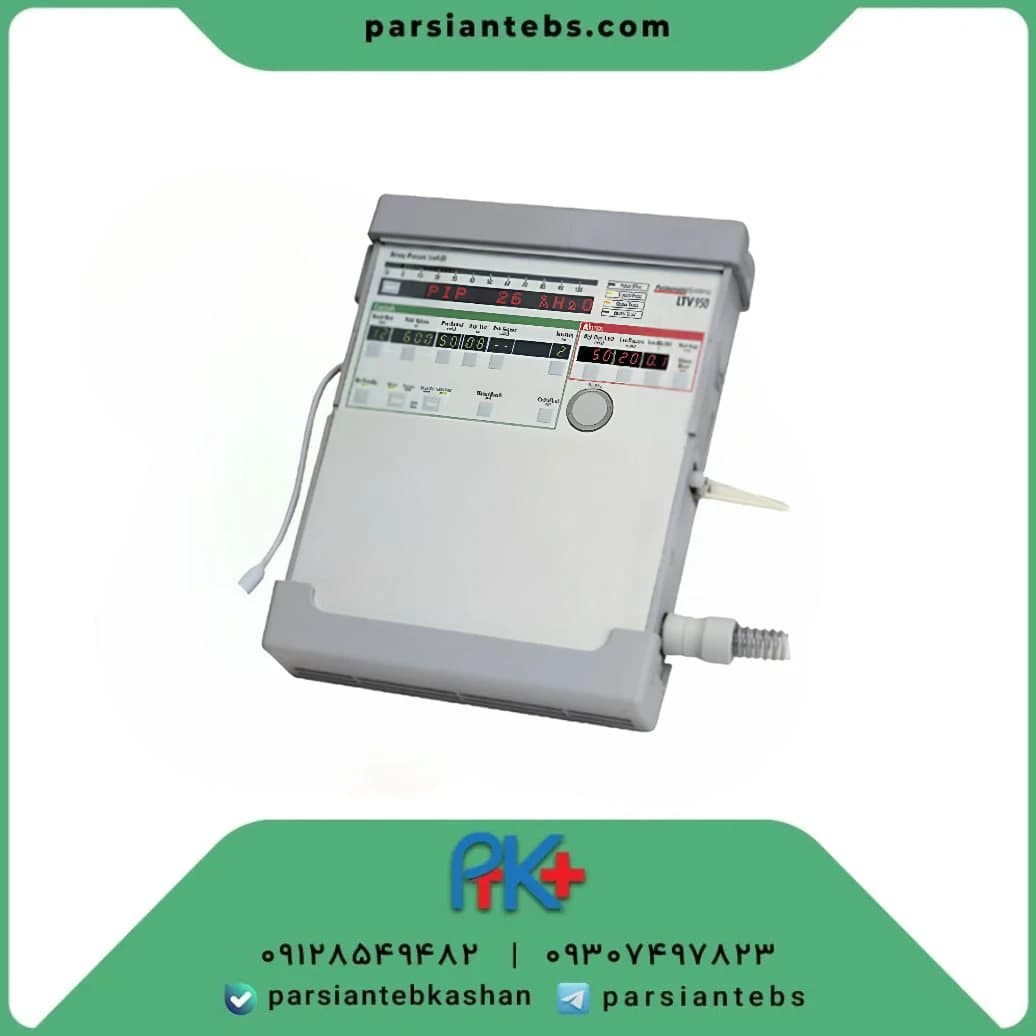
LTV 950 portable ventilator
Need assistance?
Product description
What is the LTV 950 portable ventilator?
When it comes to caring for patients who need respiratory support, choosing the right ventilator becomes extremely important. The LTV 950 portable ventilator — one of the well-known devices in the field of mechanical ventilation — is designed to provide respiratory support to patients in a variety of situations.
The LTV 950 belongs to the family of portable ventilators and was designed to provide mechanical ventilation in situations where the ability to move the device matters. This has made it a device of interest for healthcare settings, patient transport, and situations in which the patient needs respiratory support.
The LTV 950 ventilator's relatively compact design compared with many stationary hospital ventilators is one of its important strengths. A device that offers mobility alongside mechanical ventilation capabilities is more useful to care teams in a wide range of situations.
It must be emphasized, however, that the LTV 950 is a specialized medical device, and its respiratory parameters must be set by a physician, respiratory therapist, or trained clinical staff. The ventilation mode, tidal volume, pressures, breath rate, and other parameters must be determined based on the patient's condition and the care team's orders.
Main Features and Benefits of the LTV 950 Portable Ventilator
Portable, easy-to-carry design
One of the most important features of the LTV 950 is its portable design. Unlike some large ICU ventilators that are designed mainly for use in a fixed location, its portable construction makes the device easier to move.
This is an important advantage for patient transport, care outside the ward, and situations where quick access to the device matters.
Suitable for mechanical ventilation
The main function of a ventilator is to help provide the ventilation a patient needs. The LTV 950 is designed to deliver mechanical ventilation and, with the appropriate settings, can provide the respiratory support the patient requires.
However, the ventilation type and device settings must be chosen according to the patient's clinical condition, and using the device without specialized training is not recommended.
Suitable for various respiratory care situations
Because the device is portable, its use is not limited to one fixed setting. Depending on the patient's condition and the facility's protocols, a portable ventilator can be used in situations such as patient transport or respiratory care outside the ICU.
Designed for patient transport
In many clinical situations, ventilator-dependent patients must be moved between wards or even between healthcare facilities. In such cases, a portable ventilator can make the transfer process simpler.
Compatible with appropriate respiratory equipment
A ventilator on its own is not a complete respiratory care system. The breathing circuit, filters, patient interfaces, and other accessories must be chosen to suit the device and the patient's condition.
Using compatible, standard accessories plays an important role in the correct operation of the ventilation system.
Suitable for healthcare facilities and medical equipment providers
LTV 950 portable ventilator units can be a specialized option for healthcare facilities, respiratory care centers, and organizations that care for patients who need mechanical ventilation.
When buying such a device, in addition to the specifications of the device itself, the condition of the accessories, battery health, compressor, and alarm systems should also be checked.
Usable during transport
Portability is especially important when transporting a patient. A transport ventilator must be easy to move while maintaining its ventilation performance.
LTV 950 Portable Ventilator Technical Specifications
Specification | Details |
|---|---|
Product name | LTV 950 portable ventilator |
English name | LTV 950 Portable Ventilator |
Device type | Ventilator / mechanical ventilation device |
Primary use | Patient support and mechanical ventilation |
Design type | Portable |
Application | Respiratory care and patient transport |
Display | Yes |
Alarm system | Yes |
Battery | Has a portable power system; battery condition should be checked |
Breathing circuit | Requires a circuit compatible with the device |
Medical use | Mechanical ventilation |
Suitable for | Healthcare facilities, respiratory care, and patient transport |
Device condition | May be new or used, depending on stock |
Important note: The exact specifications of LTV 950 units on the market may vary depending on the version, production series, device condition, and included equipment. Therefore, parameters such as the exact pressure range, tidal volume, breath rate, FiO₂, weight, dimensions, battery capacity, and ventilation modes should be verified against the device's rating plate, the manual for that specific version, and the device's condition.
Why choose the LTV 950 ventilator?
The medical equipment market offers various ventilators for use in the ICU, patient transport, and respiratory care. The choice between them should be based on the patient's condition and the needs of the healthcare facility.
The main advantage of the LTV 950 compared with many large, stationary ventilators is its portable design. This makes the device a practical option for situations where moving the patient matters.
On the other hand, when buying a used ventilator such as the LTV 950, the device's technical condition is extremely important. A device simply looking intact cannot guarantee that it works correctly.
Therefore, when buying a used unit, it is recommended that a technical expert check the device's performance, battery health, compressor condition, alarm system, display, internal circuits, and output.
What applications is the LTV 950 ventilator suitable for?
Transporting ventilator-dependent patients
One of the most important uses of portable ventilators is during patient transport. Patients who depend on mechanical ventilation may need a portable ventilator when being moved between wards or healthcare facilities.
Respiratory care
This device can be used in respiratory care systems; however, how it is used and its settings must be determined by the care team.
Healthcare facilities
Hospitals, healthcare facilities, and patient care centers may need portable ventilators for specific situations.
Situations where mobility matters
When a stationary ventilator cannot be used or the patient needs to be transported, the portable design of the LTV 950 can be an important advantage.
Ventilation modes and device settings
Ventilators are highly specialized devices, and their capabilities depend on the version and configuration of the device. Parameters such as tidal volume, pressure, breath rate, inspiratory and expiratory time, trigger sensitivity, and inspired oxygen level are among those set according to the patient's condition and the ventilation mode in use.
With the LTV 950 as well, settings must not be changed by trial and error or without specialist knowledge. Even changing a single parameter can affect the patient's ventilation.
For this reason, if you plan to buy this device for a healthcare facility, it is best to also consider user training and a performance check of the device.
What should you look for when buying an LTV 950 ventilator?
1. Technical condition of the device
If the device is used or refurbished, a technical inspection before purchase is very important. The device should be checked for ventilation performance and its internal systems.
2. Battery health
The battery is one of the most important parts of a portable ventilator. Battery capacity and health directly affect how long the device can be used without mains power.
3. Checking the alarm system
The device's alarms are an important part of its safety system. When buying, the operation of the device's alarms and alerts should be checked.
4. Checking the display
Correct display of respiratory parameters and device status is very important. Any problem with the display can make the device difficult to use.
5. Checking the accessories
The breathing circuit, filters, connectors, and other accessories must be compatible with the device, and their condition should be checked.
6. Service and calibration
For specialized respiratory devices, regular servicing and inspection are very important. If you are buying a used device, it is best to know when it was last serviced and calibrated.
Safety tips for using the LTV 950 ventilator
Using a ventilator is different from using other medical equipment. This device is directly connected to the patient's breathing, and any incorrect setting can be dangerous.
Device settings must be configured by a specialist.
Check the device's operation before connecting it to the patient.
The breathing circuit and filters must be intact and appropriate.
Check the battery status before transporting the patient.
Device alarms must not be disabled without investigating the cause.
The device must be serviced according to the manufacturer's instructions.
The inspired oxygen level and respiratory settings must follow the care team's orders.
If a device error occurs, stop using the device and have it inspected by a specialist.
What is the difference between a portable ventilator and a stationary ventilator?
The main difference lies in the design and type of use.
Stationary ventilators are usually designed for use in settings such as the ICU and critical care units and offer extensive features for patient management. In contrast, a portable ventilator is designed with a greater focus on mobility and use during transport.
For this reason, the LTV 950 can be attractive for situations where portability matters.
Of course, being portable does not mean the device is suitable for all patients or all clinical situations. The device should be selected based on the patient's clinical needs and the care team's judgment.
Should you buy a new or used LTV 950 ventilator?
One of the key questions when buying this device is choosing between a new and a used unit.
Used and refurbished devices may be a more economical option in terms of initial purchase cost, but with specialized respiratory equipment, technical condition matters far more than appearance.
If you plan to buy a used LTV 950, items such as operating hours, battery health, compressor performance, output testing, alarms, display, and service status should be checked.
If the device has been tested and serviced and its proper operation has been confirmed by a specialist, it can be an option worth considering for healthcare facilities.
Frequently asked questions about the LTV 950 portable ventilator
What is the LTV 950 ventilator used for?
The LTV 950 is a portable mechanical ventilation device used to provide respiratory support to patients, especially in situations where mobility matters.
Is the LTV 950 suitable for patient transport?
The device's portable design allows it to be used during patient transport. However, whether it is suitable for a particular patient must be determined by the care team.
Can the LTV 950 be used at home?
Home use of a ventilator should only take place when the physician and care team have determined that it is appropriate for the patient and the patient or caregiver has received adequate training to operate the device.
Is a used LTV 950 worth buying?
If the device is technically sound, has been tested, and its battery, compressor, alarm system, and output have been verified, a used unit can be an option worth considering. Be sure to have the device inspected by an expert before buying.
Can I change the LTV 950 settings myself?
No. Ventilator parameters must be set by a physician or specialist based on the patient's condition. Changing the settings on your own can be dangerous.
Buy the LTV 950 portable ventilator from Parsian Teb Kashan
If you are looking for an LTV 950 portable ventilator for a healthcare facility, respiratory care, or patient transport, be sure to check the exact specifications of the device version, its technical condition, battery health, alarm system, and included equipment before buying.
Thanks to its portable design and specialized use in mechanical ventilation, the LTV 950 can be a noteworthy option for situations where moving the patient matters.
When buying a ventilator, price is not the only deciding factor. Technical soundness, actual device performance, service and maintenance, and the availability of technical support are far more important.
To inquire about the price and availability of the LTV 950 portable ventilator and to get expert advice before buying, contact Parsian Teb Kashan and choose the option best suited to your needs.
Technical specifications
| Condition | Pre-owned |
|---|---|
| Brand | LTV |
| Parent category | Respiratory and breathing-support equipment |
| Category | Ventilator |
| Product code | PTK-P-0030 |
| Weight | 9000 g |
| Stock availability | 2 unit |
- Product name: LTV 950 portable ventilator (used)
- Latin name: LTV 950 Portable Ventilator
- Sold as: Piece
- Price and stock unit: Piece
- Category: Ventilator
- Product code: PTK-P-0030
- Weight: 9000 grams
- Condition: Used
- Brand: Vyaire / CareFusion / Pulmonetic
- Device type: Portable ventilator
- Application: Mechanical ventilation of patients
- Suitable: For adults and children
- Ventilation modes: Control, A/C, SIMV, CPAP, NPPV
- Tidal volume: (Tidal Volume)50 to 2000 milliliters
- Breath rate: 0 to 80 breaths per minute
- Control pressure: 1 to 99 cmH₂O
- Pressure support: 1 to 60 cmH₂OPEEP/CPAP0 to 20 cmH₂O
- Approximate weight: Approximately 6.1 kilograms
- Portability: Yes