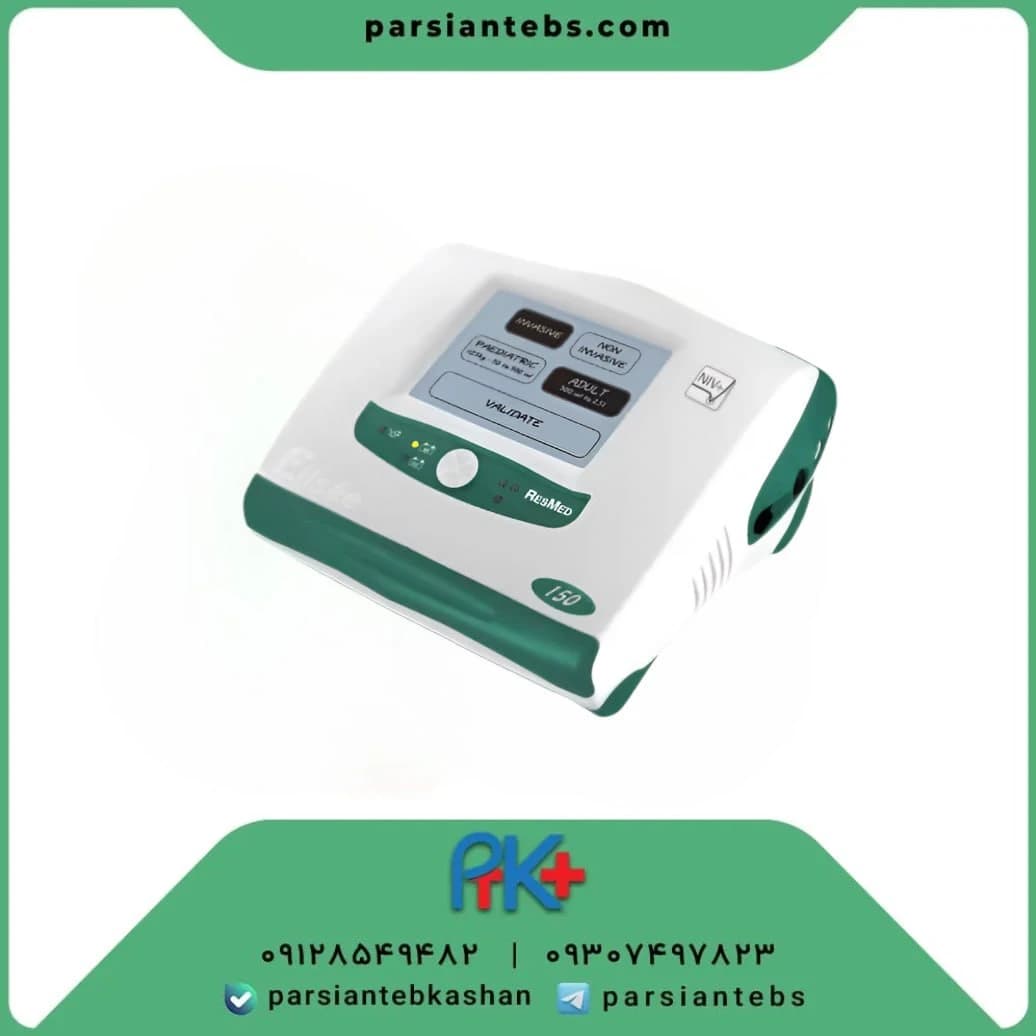
ResMed Elisée 150 Portable Ventilator
Need assistance?
Product description
What is the ResMed Elisée 150 portable ventilator?
If you need a professional ventilator for a patient that, in addition to specialized features, can also be moved and used in different settings, the ResMed Elisée 150 portable ventilator may be one of the options worth considering. This device is one of ResMed's specialized mechanical ventilation products and is designed for use at home, in healthcare facilities, and in hospital settings.
One of the key features of the Elisée 150 is its flexibility in ventilation type. The device offers both pressure-controlled and volume-controlled ventilation and can be used in invasive and non-invasive modes. As a result, depending on the patient's condition and the prescribed treatment plan, it can be used for a range of respiratory needs.
Its relatively compact design, touchscreen display, rechargeable battery, and compatibility with different circuits mean that the Elisée 150 is considered, more than a stationary ventilator, for situations where moving the patient or the device matters.
It should be noted, however, that the Elisée 150 is a specialized ventilator, and its settings must be configured by a physician or respiratory specialist. The choice of ventilation mode, pressure, tidal volume, breath rate, and other parameters must be based on the patient's clinical condition.
Features and Benefits of the ResMed Elisée 150 Ventilator
1. Pressure and volume ventilation
One of the main strengths of the Elisée 150 is the ability to choose between different ventilation methods. The device can deliver pressure-based or volume-based ventilation, which provides greater flexibility for use in different clinical situations.
This capability is very important for patients whose respiratory needs cannot be met with a single fixed method, and it allows the care team to choose a more suitable plan for the patient.
2. Suitable for invasive and non-invasive ventilation
The ResMed Elisée 150 portable ventilator is designed for both invasive and non-invasive ventilation. Therefore, depending on the patient's condition, it can be used together with the appropriate equipment and circuit.
However, the circuit type and connection method must be chosen exactly according to the physician's prescription and the device instructions.
3. Portable design and manageable weight
With a device weight of approximately 3.7 kilograms and dimensions of about 29 × 25 × 13 centimeters, the Elisée 150 is easier to move than many stationary ventilators.
This is especially useful when the patient moves between home, a healthcare facility, or other settings.
4. Rechargeable internal battery
The Elisée 150 is equipped with an internal lithium-ion battery. According to the official specifications, the internal battery provides a runtime of at least 6 hours under specified test conditions.
Of course, this figure is not fixed for all situations; battery consumption depends on the device settings, circuit type, battery condition, and conditions of use.
5. Touchscreen display and practical user interface
Another strength of the Elisée 150 is its large touchscreen display. Treatment and ventilation status information is shown on the screen, allowing professional users to view the required parameters more easily.
Clear display of respiratory data makes it simpler for the care team to operate the device and monitor the patient's condition.
6. Support for single-limb and dual-limb circuits
The Elisée 150 can be used with single-limb and dual-limb circuits, giving the device greater flexibility in different clinical situations and making it possible to choose a circuit that suits the patient's needs.
The circuit type used must be selected based on the patient's condition, the ventilation method, and the device instructions.
7. Suitable for adults and children
This device is designed for adult and pediatric patients, and in pediatric mode a respiratory rate of up to 80 breaths per minute can be set.
This means the Elisée 150 is not limited to a single age group; however, choosing the right settings for a child or an adult is a highly specialized task and must be done by a physician.
8. PS.VT mode for more specialized support
One of the standout features of the Elisée 150 is its PS.VT mode, which uses pressure support with a guaranteed tidal volume. This feature can be important in certain clinical situations, including for some patients with a tracheostomy.
Modes like these place this device in the category of specialized ventilators rather than simple breathing-assist devices.
9. Treatment data monitoring
The Elisée 150 can display treatment data and parameters on its screen. In some configurations, FiO₂ information can also be viewed.
This helps the care team better review the device's performance and ventilation parameters.
10. Alarm system for greater safety
The Elisée 150 has a set of ventilation-related alarms. Alarms for issues such as circuit problems, apnea, battery, pressure, and certain respiratory parameters can help the care team quickly identify abnormal conditions.
A proper alarm system is extremely important, especially during long-term ventilator use.
ResMed Elisée 150 Portable Ventilator Technical Specifications
Specification | Details |
|---|---|
Brand | ResMed |
Model | Elisée 150 |
Device type | Portable ventilator |
Application | Invasive and non-invasive ventilation |
Patient group | Adults and children |
Ventilation type | Pressure and volume |
Circuit | Single-limb and dual-limb |
Device weight | Approximately 3.7 kilograms |
Dimensions | 290 × 250 × 130 millimeters |
Internal battery | Lithium-ion, 14.4 volts, 6.3 ampere-hours |
Internal battery life | At least 6 hours under specified test conditions |
External battery | Supported |
Battery charging time | Approximately 6 hours |
AC power input | 110 to 240 volts, 50/60 hertz |
DC power input | 12 to 28 volts DC |
Maximum DC input current | 15 amperes |
Maximum power consumption | 75 VA |
Maximum delivered pressure | Approximately 60 cmH₂O |
Display | LCD touchscreen |
FiO₂ monitoring | Optional oxygen sensor/cell can be used |
Low-pressure oxygen port | Yes |
Ventilation modes | Pressure control, volume control, ACV, PACV, SIMV, PS, and other supported modes |
Alarm system | Yes |
Device classification | Class II, Type BF |
Why choose the Elisée 150 ventilator?
When choosing a ventilator for a patient, the ability to generate sufficient pressure is not enough on its own. Flexibility, portability, circuit type, multiple ventilation modes, the alarm system, and battery operation are also very important.
In this respect, the Elisée 150 offers a good combination of specialized capabilities and portable design. Compared with simpler devices, pressure and volume ventilation, single-limb and dual-limb circuits, and a variety of ventilation modes give the care team more freedom to choose the most suitable approach.
On the other hand, compared with many stationary ventilators, its weight of approximately 3.7 kilograms and rechargeable internal battery are a significant advantage.
In fact, if you are looking for a professional portable ResMed ventilator that can be used both at home and in healthcare facilities, the Elisée 150 is an option worth considering.
Which patients is the Elisée 150 suitable for?
This device is designed for adult and pediatric patients with acute or chronic respiratory conditions and can be used for invasive and non-invasive ventilation.
One of its key applications is for patients who need long-term mechanical ventilation and may spend part of their time at home and part in healthcare facilities.
In addition, the rechargeable battery makes the device more practical in situations that require moving around.
That said, the Elisée 150 is a specialized medical device and must not be used without a physician's prescription or specialized training.
How the Elisée 150 differs from simpler respiratory devices
Buyers sometimes confuse ventilators, BiPAP machines, and breathing-assist devices. The Elisée 150 should not be regarded as just an ordinary BiPAP or CPAP device.
This device is designed for professional mechanical ventilation and supports a variety of ventilation modes, different circuits, pressure and volume settings, and monitoring and alarm systems.
For this reason, the Elisée 150 should be chosen based on the patient's actual needs, not simply because it has more features.
Important points when buying the Elisée 150 ventilator
Anyone who intends to buy the ResMed Elisée 150 portable ventilator should check a few points before purchasing:
Check the technical condition of the device and the proper operation of the turbine and ventilation system.
Test the health of the internal battery.
Check the device's display and touchscreen.
Test the operation of the alarm system.
Determine the circuit type and accessories the patient needs.
Check the condition of the sensors and accessories.
For used units, the device's service and maintenance history is very important.
Device settings must always be configured according to the physician's prescription and advice.
When buying a used ventilator, the device's appearance alone is not a reliable indicator of its condition. The actual performance of the device, battery, sensors, alarm system, and accompanying circuits must be checked.
Frequently asked questions about the ResMed Elisée 150 ventilator
Is the Elisée 150 suitable for home use?
Yes. The Elisée 150 is designed as a portable ventilator for use at home and in clinical settings. However, home use must be supervised by the care team.
Can the Elisée 150 be used for children?
Yes. This device is designed for adults and children and has dedicated pediatric mode settings. The appropriate settings must be selected by a physician.
How long does the Elisée 150 battery last?
According to the official specifications, the internal battery lasts at least 6 hours under specified test conditions. Actual runtime may vary depending on the device settings and the patient's condition.
Can oxygen be connected to the Elisée 150?
Yes. The device has a low-pressure oxygen inlet and, in the appropriate configuration, can be used for oxygen enrichment. How oxygen is used and in what amount must follow the physician's orders and the device specifications.
Does the Elisée 150 work with a dual-limb circuit?
Yes. This device supports single-limb and dual-limb circuits, and the circuit should be chosen based on the ventilation type and the patient's condition.
Buy the ResMed Elisée 150 portable ventilator from Parsian Teb Kashan
If you are looking for a professional, multipurpose portable ventilator, the ResMed Elisée 150 is a noteworthy option for specialized respiratory applications thanks to its pressure and volume ventilation, support for different circuits, internal battery, touchscreen display, and monitoring and alarm systems.
To find out about the Elisée 150 ventilator's price, availability, device condition, and purchase terms, you can get in touch with Parsian Teb Kashan.
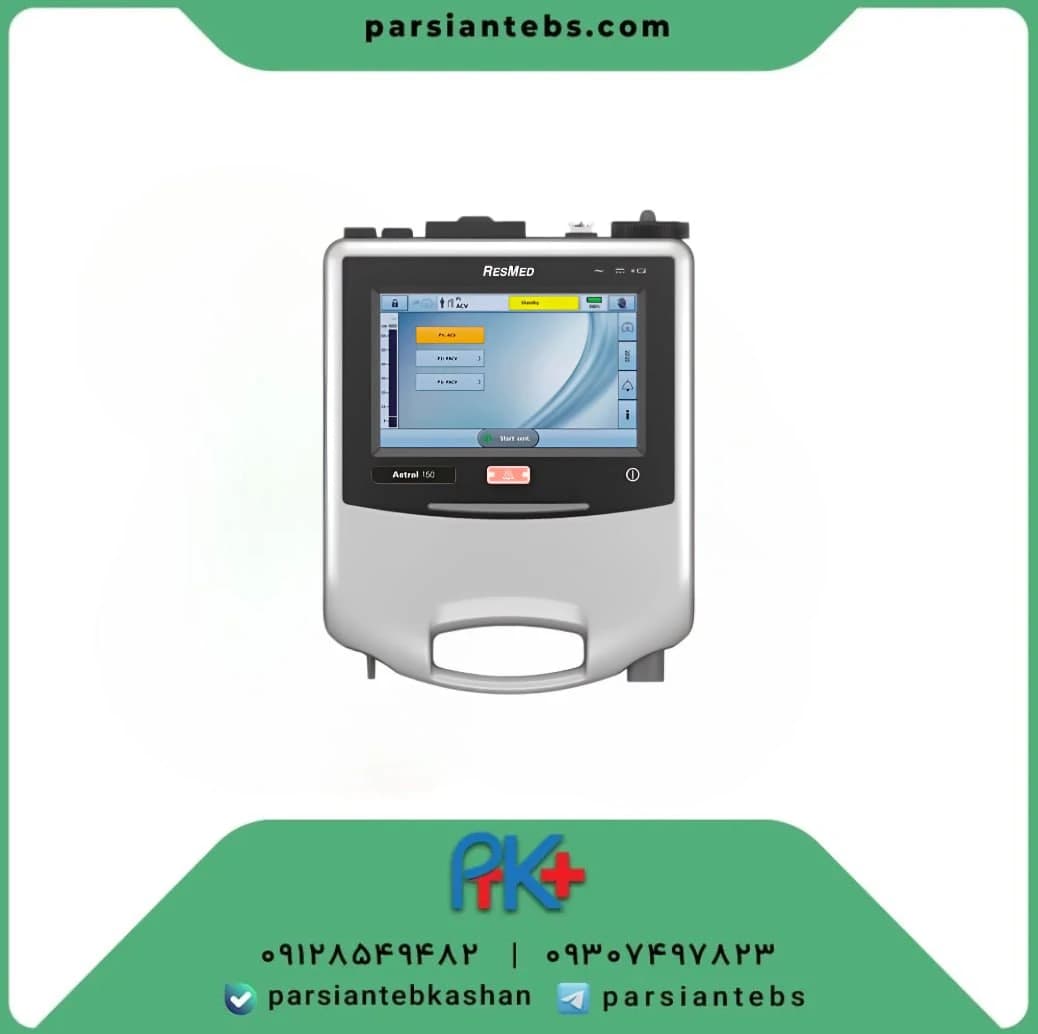
If you are unsure about choosing between the Elisée 150, Astral 150, and other portable ventilators, get advice before buying so you can choose the most suitable option based on the patient's condition and type of use.
Technical specifications
| Condition | Pre-owned |
|---|---|
| Brand | ResMed |
| Parent category | Respiratory and breathing-support equipment |
| Category | Ventilator |
| Product code | PTK-P-0028 |
| Weight | 6000 g |
| Stock availability | 3 unit |
- Product name: ResMed Elisée 150 portable ventilator (used)
- Latin name: ResMed Elisée 150 Ventilator
- Sold as: Piece
- Price and stock unit: Piece
- Category: Ventilator
- Brand: ResMed
- Product code: PTK-P-0028
- Weight: 6000 grams
- Condition: Used
- Ventilator type: Portable
- Ventilation type: Invasive and non-invasive
- Application: Mechanical ventilation of patients
- Suitable for: Children and adults
- Device weight: Approximately 3.7 kilograms
- Battery: Internal lithium-ion
- Battery runtime: At least approximately 6 hours (depending on settings)
- Power input: 110 to 240 volts AC
- Dimensions: Approximately 290 × 250 × 130 millimeters